
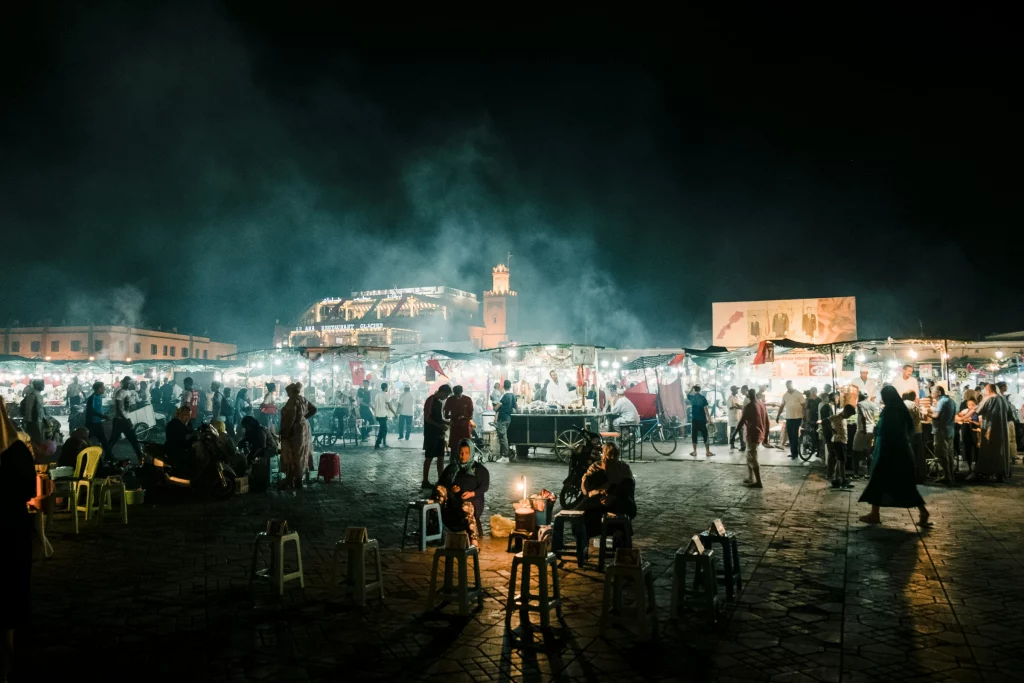
MARRAKECH
Maroc Film Services provides an all-encompassing suite of solutions designed to streamline international productions in Marrakech and throughout the Kingdom of Morocco. From the earliest stages of development, we manage script translation and extensive location scouting to find the perfect Moroccan backdrop. Our dedicated production fixers manage the complexities of local bureaucracy, securing necessary filming permits and navigating customs clearance via carnets for imported equipment. On set, we supply world-class talent and technical expertise, including professional actors and a full array of specialised departments: camera, sound, and lighting crews, as well as a comprehensive art department skilled in scenic design, wardrobe, costume, make-up design and hair styling.
To ensure every frame is visually stunning, Maroc Film Services provide high-quality set design materials and state-of-the-art camera, sound, lighting and grip equipment, alongside specialised drone hire for aerial cinematography. For indoor or controlled environments, we offer access to premier studios and sound stages. Beyond the technical requirements, Maroc Film Services also oversees the logistical comfort of the team, coordinating all transport and booking premium hotels to ensure a seamless experience for the entire cast and crew.
is a major city in the northwest African nation of Morocco. It is the fourth largest city in the country, after Casablanca, Fes and Tangier, and is the capital of the mid-southwestern region of Marrakesh-Asfi. Located to the north of the foothills of the snow-capped Atlas Mountains, by road Marrakesh is located 580 km (360 mi) southwest of Tangier, 327 km (203 mi) southwest of the Moroccan capital of Rabat, 239 km (149 mi) south of Casablanca, and 246 km (153 mi) northeast of Agadir.
Marrakesh is possibly the most important of Morocco’s four former imperial cities (cities that were built by Moroccan Berber empires). The region has been inhabited by Berber farmers since Neolithic times, but the actual city was founded in 1062 by Abu Bakr ibn Umar, chieftain and cousin of Almoravid king Yusuf ibn Tashfin. In the 12th century, the Almoravids built many madrasas (Koranic schools) and mosques in Marrakesh that bear Andalusian influences. The red walls of the city, built by Ali ibn Yusuf in 1122–1123, and various buildings constructed in red sandstone during this period, have given the city the nickname of the “Red City” or “Ochre City”. Marrakesh grew rapidly and established itself as a cultural, religious, and trading centre for the Maghreb and sub-Saharan Africa; Jemaa el-Fnaa is the busiest square in Africa.